Pre-Show
Welcome to One Cartridge Place
After an initial bag search and ticket scan by Front of House staff, audience members are handed a regular playing card ranging from an Ace to a 10 (bar the lucky few who may be fortunate enough to receive a precious ‘doodled’ card, graffitied with a quote or icon from within the show, that most definitely will not be slipped into the back pocket and taken home as an unofficial memento). Then, swiftly filing through into the plain, but modern-designed, foyer of One Cartridge Place, weaving amongst a conveniently maze-like route of barriers, you encounter the iconic red and blue fluorescent labyrinth sign on the wall, electrically humming and bearing a capitalised THE BURNT CITY.
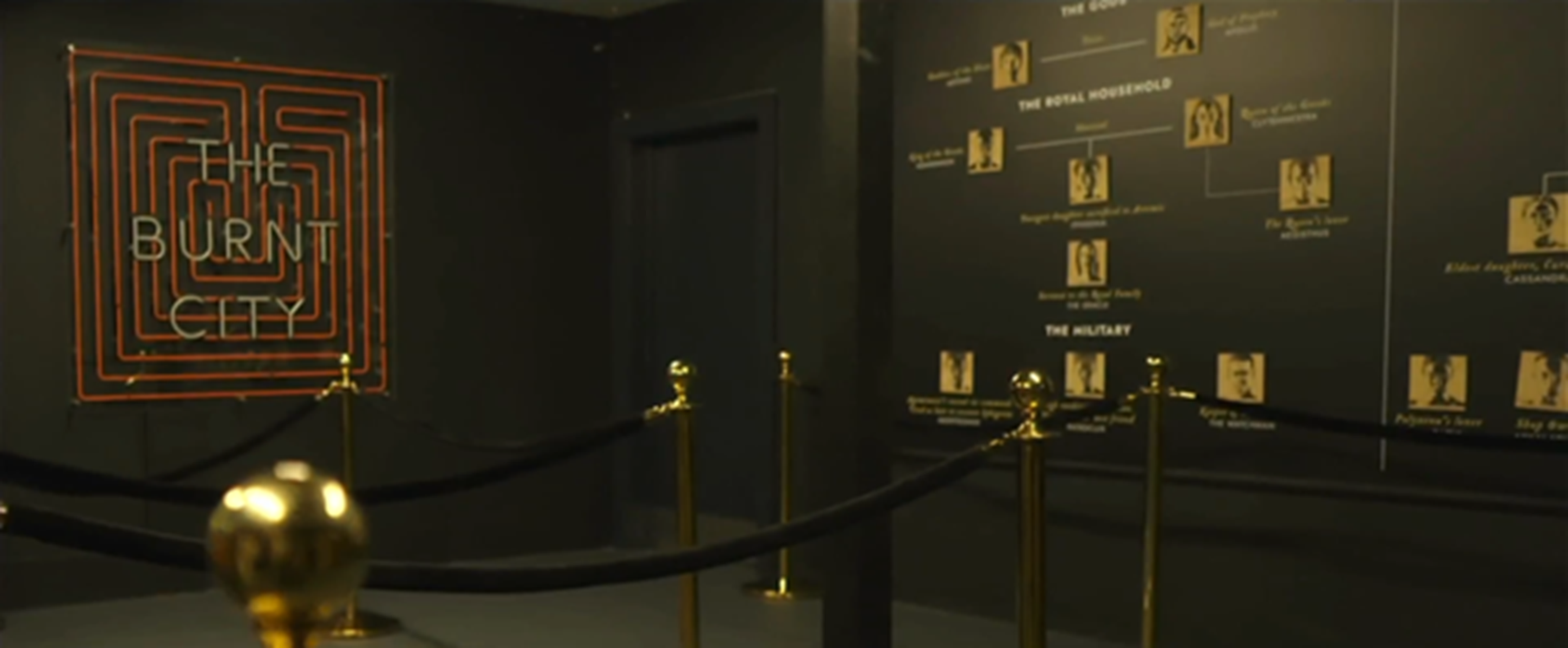
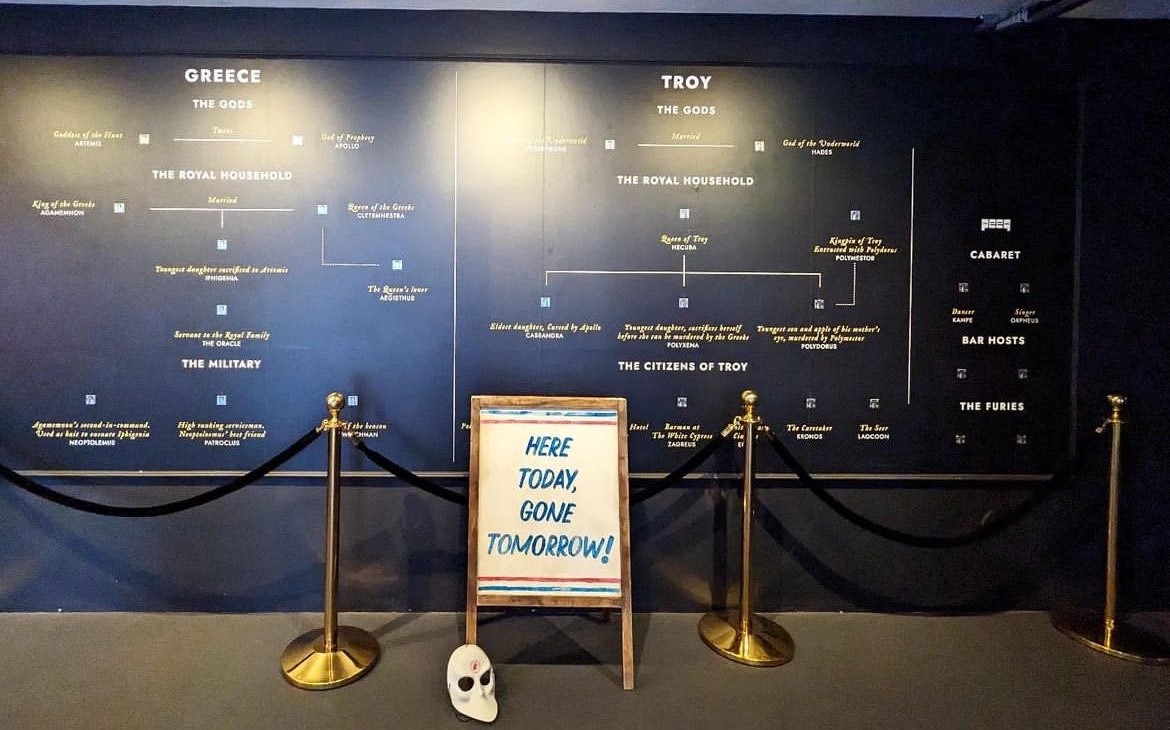
Adjacent to the ever-buzzing prime photo opportunity spot, patrons are directly greeted with a wall adorned with a array of bronze etchings, arranged to form the family trees of TROY, MYCENAE, and PEEP CABARET, each displaying the names and faces of the lost souls available for haunting that night – the blessèd cast board.
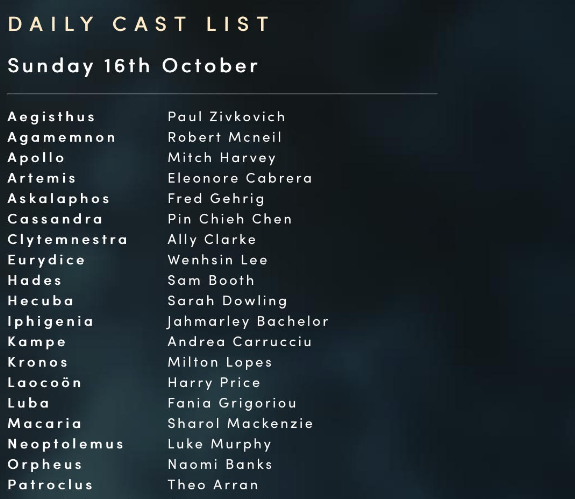
Of course we know any repeat visitor worth their weight in Hecuba’s golden headdress would have already savagely assessed, and then reassessed, the online cast list by now and formed both a plan, contingency plan and acknowledgment that they were indeed going to abandon said plans and do “the same thing they always do”, but this brief window of time still potentially serves as a last shred of hope of preparation to the newly converted fans.


Handed a small zippable, black cloth bag, and ushered through to drop off any outside belongings at the cloakroom, audiences can begin to form a queue at the entrance to PEEP – the hottest. seediest, most barely-standing bar in all of Troy. You stand in a small unassuming holding-room, walls painted black, with a chained-off metal staircase to the left (hanging on the wall beside it a simple, neon lettering sign, reading KLUB with an arrow pointing upstairs – never has one word, and one indication dripped with such sleaze, and so immediately set the tone for the bar you’re soon to be welcomed into).
Forming a short queue and greeted by one of two Front of House stewards, you are soon prompted to place your phone into the black bag, for it to be securely locked shut, ensuring the secrets of the City remain preserved safely within its walls, before being ushered ahead through two sturdy double doors and into the tempting, smoky, pendulous bosom of PEEP.

This is PEEP
Directly ahead of you (if you can make it out amongst the abundance of thick haze bending it’s way around the furnishings), stands the Main Stage, crowded by a smattering of wooden chairs and rounded tables, each decked with pink and white fibre-optic potted flowers. Static, lowly-lit and empty the stage may be, and yet the space still teems with a lingering sombre soulfulness, in part due to the dreamy cacophony of traditional 1920’s Greek folk music – such as Ziliara Mou (Chrysoula Stini) – that rings out through the overhead speakers. Unfortunately, as of yet, the many other songs featured during the pre-show have remained unidentified – one cannot help but feel this oddly prescient, as a symbol of the now decaying, fading and archaic status of Troy.
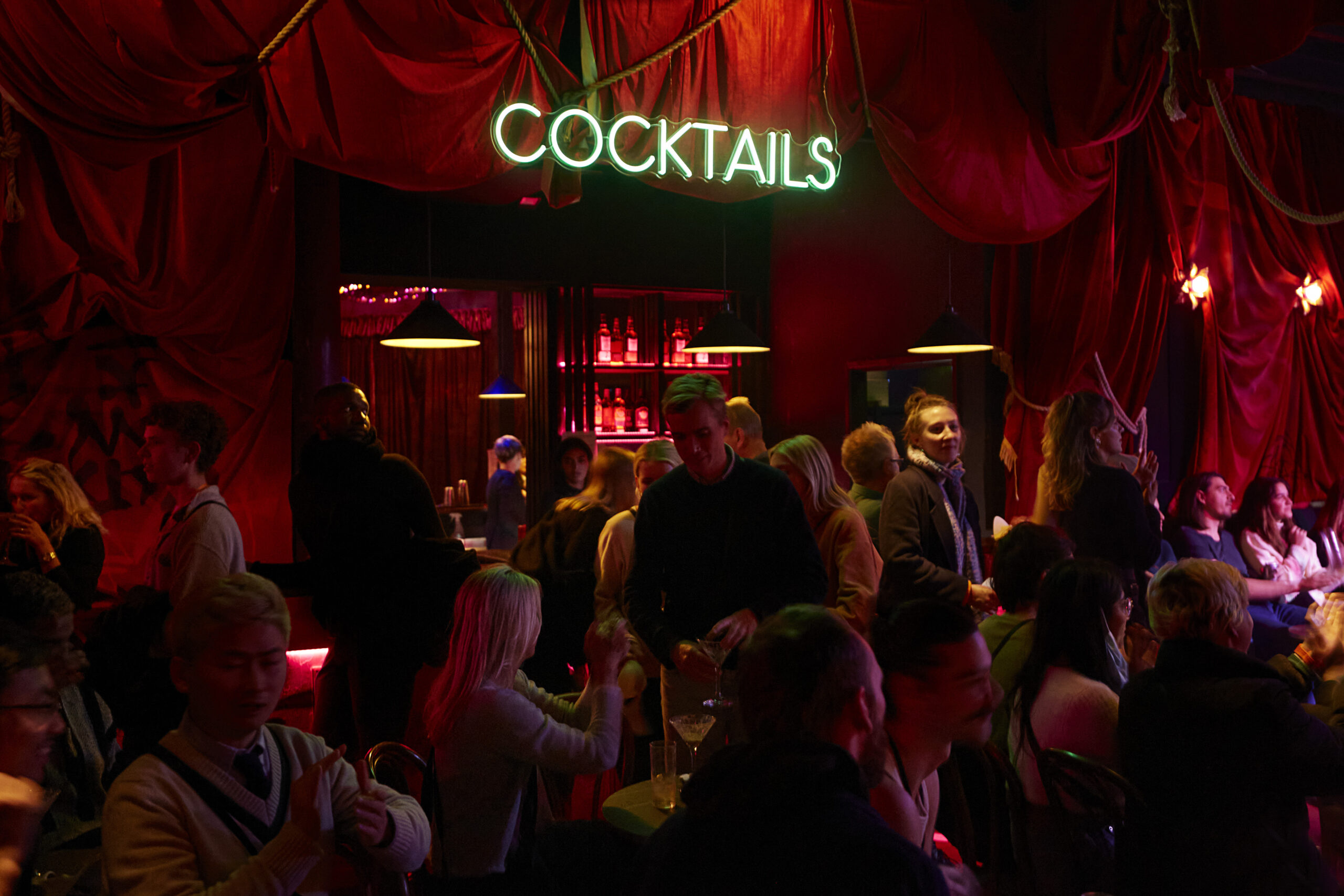
But the sensual ambience of the space is not merely auditory, as whilst the clinking of glasses and rattle of the ice bucket draws you towards a large bar to your left (glowing under the beam of a golden PEEP sign), the sweet scent of popcorn soon pervades the air, luring you across to an opposing bar on your right (emblazoned with the neon-green lettering, COCKTAILS).


Steering yourself away from the temptation of the two pop-up Sake carts, and the intriguingly flavoured chewy ice-creams available for purchase (Milky Orchid, anyone?), to your far left you find a more expansive space fitted with a variety of plush accent seating, twinkling under the light of a thousand rose-tinted fairy lights – the previous VIP area, a function now relocated to a much smaller cushioned spot roped off for all, bar the swanky few, and nestled under a canopy of weighty, velvet curtains, beside the entrance to the museum…


Before long, one of the night’s two PEEP Hosts will enter, appropriately decked out in all matter of sparkly and spangled attire and clutching a microphone, as they begin to warmly address the patrons with a tone of dripping charm and intrigue, perfectly befitting of their chosen residency:
“Hello there! How you all doing? Doing good?… Great!
My name is [NAME], and I have some very important information for all of you, so please pay attention…
I trust that when you all came in here you were each handed a playing card. Now you must keep this card safe, as it will serve as your ticket, and your ticket is for your entry to the exhibition, beyond the curtains to my right. When I call your card number and colour, please pop your card in the little box labelled ‘CARDS’, form a nice huddle just here, and when the curtains open you will be let through. If I do not call your card, please sit back, sit down, relax, have a drink, and wait your turn. Drinks are not permitted into the museum, but don’t worry you may stay here a little longer to finish them before I call your card again and you may go through. Sound good?!
Now, let’s start with… Black Ace!”
The Host will continue to call out the subsequent cards ranging from Red Aces all the way down to 10s over the next 45 minutes, announcing the allocated entry slot for each suit every 5 minutes (i.e. 2’s should enter approx. 5mins into the show’s start time, 3’s & 4’s 10mins in, 5’s 15mins in etc.).
In groups of typically 20 to 25 people (although occasionally as low as 2-5, on the nights that no one but you and your friends decide to lie about having an Ace to go in first), those with the specified suit are encouraged to deposit their card into a small slotted box on a podium, and gather at the striped curtain opening, curiously embellished with a banner reading TREASURES AND ANTIQUITIES, harkening to that of an antiquated travelling circus sideshow, luring it’s willing customers to gawk and marvel at the unfortunate pawns on display.


The Rules
Eventually the curtain is heaved open and the group is ushered through into a second (almost) all-black holding-room, with the exception of the wall-to-wall display of mounted plastic white masks. A sole steward stands atop a small podium beside a plain door, and with everyone packed in, the curtain is closed once more as the host announces:
“Please take a mask off the wall and place it on. Wonderful – you all look amazing…Now. A few safety announcements before you all head into the exhibition. Should you need any help at any point, once inside, our staff are dotted around the space. They are wearing black face coverings and a lanyard. Now these people are here to assist, they are, however, not here to guide you. For that you must find your own way. Should you need a break at any point, I’d recommend you find the bar again where you will be able to sit down, take off your mask, relax and buy yourself a drink.

Now we do have some rules for within the exhibition, so do listen carefully:
No photography. No talking. No running – it can be dark in there so please take care. Whilst we encourage you to explore and delve into the details, I must insist that you do not move anything, and you certainly do not take anything. Keep a respectful distance between yourself and any… interesting characters you may find inside. And absolutely no pushing and shoving – anyone seen doing so will be removed, and besides we tend to find a greater perspective can be gained from a distance.
You will be going in shortly, and when these doors open please make your way through as quickly and quietly as possible. But know that should you become separated from your loved ones at any point, please don’t panic, as I’m sure you’ll be reunited with one another back at the bar, in the end… hopefully…
Good luck.”
With that, a white LED box above the door lights up as all are promptly granted access through and into the first museum exhibit…
The Curator
Within the next equally small, although considerably darker, room stands a solitary museum display plinth highlighted by a bright spotlight, showcasing beneath it’s glass casing, a deteriorated stone replica of the same white masks as seen previously, with a small plaque reading PURPOSE: UNKNOWN. After a few moments of silence, as everyone begins to squeeze in shoulder-to-shoulder filling the space surrounding the ring of light, from within the pitch edges of the room emerges a tall, smartly-suited man with an inherent air of mystery, and perhaps vague tinge of distrustfulness; meet the curator, Hades. He takes his spot within the light and addresses the group directly:

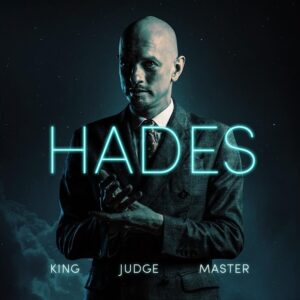
“Hello. Thank you for coming to see my collection of antiquities.
Half museum, half maze; each of you must find your own way. Embrace your own fate.
Yours…
He sets his sights on a random WM.
…I believe, lies this way.”
A white LED box above one of two identical black doors, reading the words EXHIBITION CONTINUES alights, as he points to the door – the WM swiftly follows their fate. With them gone, he continues:
“Now. I suggest that you all say goodbye to your friends, let go of your loved ones for now, for your own good and for theirs.
You have to find your own way, that’s the only way that you’ll understand. And don’t worry if you get lost, you are already lost; that’s why you came here – into the dark, to see the light. Not to be told a story, not to learn a history lesson, but to live inside a dream. A strange, vast, ungraspable dream, full of mysteries. Who’s next…?”
He looks around expectantly and awaits the raised hand of a volunteer – he finds one, points them out:
“You! Stay there! The rest of you, this way. Off you go.”
The second door lights up and all but one continue on through. Just before the group leave his earshot, he urgently calls out after them:
“Don’t look back, never look back!”
Finally he beckons in the remaining WM with a crooked finger, firmly places a hand on their shoulder, leans in and in a hushed tone utters:
“Now, this labyrinth has many, many centres.
A different centre for everyone, so you must turn your fear into desire.
Find out whatever is waiting for you, this way.”
The first door relights, and the WM is encouraged to venture on through it alone.
Audio Tour
A guided audio tour (narrated by Sam Booth) spills out through loud-speakers across each of the following museum exhibit rooms as audiences pass through them, regardless of directional entry – however the final phrase referencing the Schliemann quote is exclusive to the Troy entry, and plays only within the Upstairs of the Palladium, and as the WMs descend the staircase leading them directly into the City:
“In the ancient Greek’s worldview, mortals lived at the mercy of the whims of the Gods. Divinations were an essential practice to discern the Gods and understand their will. Establishing and maintaining good relations with these higher powers often called for a sacrifice to prevent natural disasters or falling slaves to war. Sheep, goat, ox would all be killed in honour of the deity. Extreme circumstances would require a human body – the purifying sacrifice of a young woman was considered the ultimate act of submission and deepest devotion to the divine…
The stories surrounding the Trojan war show the devastating cost of conflict, for winners and losers alike. In Mycenae, Queen Clytemnestra is consumed with grief, after King Agamemnon sacrifices their beloved daughter Iphigenia to appease the God Artemis, so that a favourable wind will bring the Greek fleet to Troy. And in the aftermath of the fall of her city, the Trojan Queen Hecuba is devastated by the deaths of her last surviving children, her daughter Polyxena, killing herself before she could be sacrificed by the invading Greeks.
Revenge is a common theme of these legends. In Troy, the Blinding of Polymestor is Hecuba’s brutal revenge on the man to whom she had sent her son, Polydorus, for safekeeping, but who treacherously murdered him instead. And in Mycenae, the victorious Agamemnon returns home in glory, only to be immediately struck down by his Queen in retribution for the death of their daughter.
Heinrich Schliemann claimed to have discovered Troy in his excavation in Hisarlik, in Turkey. He found great fortifications beneath a layer of ash; the remains of a city destroyed by a fire. The treasures he unearthed made him famous throughout the world and yet he was still not satisfied. In his later years he turned his attention to researching and re-enacting the practices of mystery cults, whose worshippers drank hallucinogenic concoctions from vessels such as these, and took part in rituals to transcend the world of appearances and commune with the Gods…
Schliemann wrote: “The world of the ancients cannot be found by digging down into the Earth. The past is never past. It is here now, for those with eyes to see, and mine now are open wide. For I have drunk the kykeon, and I looked upon the face of Agamemnon and through the great gates I entered at last that place I had dreamed of all my life, My Burnt City.”
Left Door
Those let in through the left door take a sharp right, immediately filing up two flights of stairs, and then through a series of further museum exhibition rooms – all of equally plain, black-walled and low-lit design as the initial one. Audience members are free to peruse the exhibits at their own pace, absorbing the details of the cased artifacts with closer inspection, or (as most returning visitors do) eagerly dash through each one at breakneck speed, in hopes they haven’t already missed too much of the action in the show.
Within the first room stands a plinth displaying a simple rounded clay vase, with two handles, depicting a painted image of Hecuba’s blinding of Polymestor, as a black-and-white projection of the Trojan family tree (matching that of the one seen in the foyer earlier) is cast across the wall behind. Continuing on through the second room, and further still into the third, audiences are met with a display case containing a lock of fair-coloured hair, bound with coloured thread – an offering for the Gods.
Finally venturing through the fourth door, the WMs will suddenly find themselves upstairs of The Palladium, in Troy. It is considerably more expansive and well-lit than the previous few spaces, with rich red-painted walls and four large arched, floor-to-ceiling windows spanning the far right wall, (with a locked door beside them leading onto the Palladium balcony), overlooking The Square. Occupying the centre of the otherwise empty space, however, stands one final exhibit beneath its glass confines – a detached record needle, also with a small plaque reading RECORD PLAYER NEEDLE – DATE UNKNOWN.
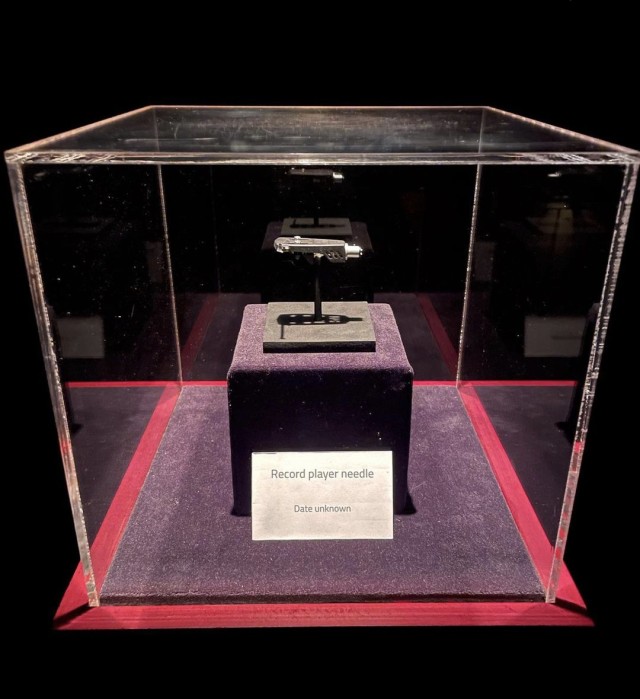

Should the observer manage to steer their attention away and onwards on their journey, they would find that directly opposite the needle lies another two flights of winding staircases – descending the steps, all the while passing a series of framed, vintage-designed posters for all manner of theatrical productions, that were performed at this once glimmery beacon of light entertainment, one would soon reach the ground floor, and with a sharp right through a final open door, promptly make their entrance into the City of Troy.
Right Door
Through the right door, however, and after taking a sharp left down a long sloped corridor, audiences are met with a display case, presenting a simple clay vase, depicting a painted image of Clytemnestra’s Murder of Agamemnon. Occupying the second room are two small kykeon vessels decorated with references to the Goddesses Demeter and Persephone, as a black-and-white projection of the Mycenaean family tree (matching that of the one seen in the foyer earlier) is cast across the wall behind. Leading on from there, the third room’s exhibit displays a smashed empty case, with loose glass shards littering the plinth – the only hint of its original contents being a small plaque that reads SACRIFICIAL ANTLERS.
Pursuing through the final door, the WMs will suddenly find themselves met with a wall of pitch-black, the faint glow of a flickering candle in their periphery, their only aid in allowing their eyes to adjust – they have unknowingly stumbled in through the back entrance to the Tent Maze, that once navigated through its many trailing curtained walls, will lead directly into the heart of the No Man’s Land of Mycenae.

Off you go. Don’t look back. Never look back.